Translate This Blog

Friday, August 9, 2013

Bruce Lee in the Dojo - Victim in the Street!

Another entry sure to annoy many . . .

A couple of months ago I received a cracked rib when a lady in a chemically induced psychosis kicked the crap out of me with her boot. I had already been think a lot about Kumite training and that incident, coupled with an article I read on-line entitled "5 Reasons Karate is Useless" gave rise to the following diatribe.

Every school applies a different significance to sparring as the Hanshi of the style sees fit. At the same time EVERY type of sparring has it's own benefits and it's own failures.

First there's the concept of sparring, i.e. Kumite, in itself. "Kumite" does NOT mean sparring but rather "Grappling hands".

There are four types of Kumite:

1) Yakusoku Kumite which translated, means "Promise Kumite" Some styles call this Gohon Kumite. This is the most basic form of Kumite. I attack, you know I'm attacking, and how to defend. No surprises

Purpose; For the neophyte to begin working with other students, focus on and develop timing, accuracy and attacking/defending while moving with a partner.

Yakusoku Kumite is further divided into three sub-divisions:

     (a) Ippon kumite - one step sparring, frequently used in basic technique drills

     (b) Sanbon kumite - three step sparring, typically used to develop speed, strength, and technique.

     (c) Kiso kumite - structured sparring based specifically on the movement from one of more kata

Disadvantages: None, IF, used properly in a systematic training curriculum.

2) Jiyu Kumite translated means "Free sparring". Working with a partner but you do not know what technique will be utilized and what technique you will use to defends/attack

Purpose; Develops "Mizo no kokuro" (mind like water) . If you think about what technique you will use, you'll get hit. Liberating the mind and instinctively responding with a block or strike is the epitome of success in Jiyu Kumite. Because of this most schools do not allow mudansha below the rank of go-kyu to participate.

Disadvantages: Many. Mostly the limitations of the approach; e.g. there are usually no-contact zones, limited contact zones. But the biggest advantage is the more we try to make Jiyu Kumite "authentic" or "Street worthy" the more we fail.

Example: Many schools may advertise "full-contact karate" but not to the head. The great kicker will love this approach but it sets that individual up for failure and even injury in real life. If I'm 6 foot 4 and can kick the crap out of you before you can get close enough to kick me I have an advantage. However since I do not have to worry about a Monkey fist to the temple I soon fail to protect my head.

In the street I'll take a kick most any day in order to get close enough to deliver a shuto to your temple. You may hurt me but I'll K.O. you. Who wins? The lawyers.

3) Shigoki (savage training) - While "Shigoki" is not true Kumite, Kumite engaged in during shigoki is similar to a "beat down initiation" into a gang. No respectable karate school engages in such training although there is the occasional exception usually including a perp parade on the nightly news.

Purpose: No valid purpose. Seeing how much of a beating does not make you a man - it simply means you're stupid enough to be a human punching bag - Think of it as martial arts bullying.

4) "Authentic" Kumite. This fourth type of Kumite does not have an actual name (if you know differently please contact me).

In Okinawa it was not unheard of for a karate student to venture into town or over to the "bad part of the village" (i.e. "B.C.Street") and get into a fight purposefully to perfect their techniques in a "real" fight.

While in our politically correct society this sounds abhorrent, it WAS extremely effective. NOTHING in a dojo can prepare you for the adrenalin rush, the concentration narrowing of a true fight. There is no break, no time out, no pulling of punches and no forbidden techniques. Authentic Kumite is the real-deal from another age and another time

So, the best BAD reasons to engage in Kumite training:

1. This is Florida, everyone carries a gun. Karateka's who develop defenses against guns are known as "the dearly departed".

2. You fight the way you train. So unless you allow all full-contact attacks and blocks (including eye gouges, traumatic testicular rupture, tracheal strikes, do not wear any protective equipment [jock, gloves, mouth guards, etc.] AND you wear combat boots when sparring) Then you are delusional and what's more you're endangering your students and your home (which is what the lawyers will sell to pay your court judgment.)

3. You scare off students by engaging them in Kumite before they have developed the basics needed to support their training.

4. Talented students are misled to believe they will be capable of successfully defending themselves in the street.

5. A karate student training to fight another karate student, so you can learn to protect yourself against a street thug, is sort of like practicing Spanish with another student studying Spanish so you will be ready to speak Portuguese on your vacation.

6. If you feel more "manly" by thumping and getting thumped in Kumite classes you have deeper seated issues which should be addressed at a psychological level before you continue your martial arts training.

Okay, enough bitching. What role does/should Kumite have in karate training? Consider the diagram below (specific to my conceptualization of Matsubayashi-Ryu)

So now you're thinking, sounds boring. What is the "secret" of being ready and capable of defending yourself in the street.

Makiwara training.

Makiwara training teaches you how to deliver devastating attacks AND blocks. Who cares how fancy or special your "spinning round house flying reverse monkey stomp kick" is if you have trained yourself to make EVERY block an attack, every straight punch a pile driver, every shuto a katana and every kick a jack hammer?

In your first "real" fight you will remember nothing; but your body will automatically respond (muscle memory) with what you have practiced the most, i.e. (1) Chudan-uke, (2) Chudan-zuki, and (3) Mae-geri.

If you have enough control, presence of mind, to deliver fancy advanced attacks, you're clearly fighting an unprepared opponent. That's not karate.

Anyway that's my approach. Like it, modify it or blow it off. - - T.F.Y.Q.A.

For my brothers and sisters in budo,

Cox Hakase

Oh. A request; if you read this blog and like or hate it please consider clicking on the "Join This Site" button above. Sometimes I feel like I'm talking to an empty room. - THANKS!!

Sunday, May 12, 2013

Can You Use Your Kata With Kumite?

      Student: "Is that Tai Chi or something?"
      Sensei: "It's karate."
      Student: "What's the name of the kata?"
      Sensei: "It's Pinan Shodan."
      Student: "?????? What style is that?"
      Sensei: "Matsubayashi-Ryu. Direct from O'Sensei Nagamine."
      Student: "Huhh! I train in Maysubayashi-Ryu, why is your kata so different?"
      Sensei: "You're just doing gymnastics."
      Student: "Why?"
      Sensei: "Can you use your kata with Kumite?"
      Student: "No, I can't."
      Sensei: "So, . . you're just doing gymnastics."
      Student: "Sensei, can you use your kata for Kumite?"
      Sensei: "Let's see. Come at me."
      Student: "Are you sure? You're pretty old? Ok . . . Pow, ouch!!"
      Sensei: "Senpai, you'll be okay. Just lie there and take deep breaths, just breath."

            (Adapted from Higaki Gennosuke)

   A couple of weeks ago I had the opportunity to attend a seminar focusing on bunkai. The seminar was sponsored by Liberty Karate Club in Orlando and was conducted by Shihan Joche Zapata, 6th dan Matsubayashi-Ryu, 7th dan Matsumura Seito, and 7th Dan Hakutsuru (White Crane).

   I'm not one to be impressed by high dan rankings. Too many self promoted "masters" out there and even some who allow their students to actually promote them to high ranks (hachi-dan, ku-dan, etc.). However Shihan Zapata is a student of Hanshi George Alexander whose credentials are well known throughout the martial arts world.

   This was a two day seminar. By the second day the pieces started to fit together. I began to see kata movements in a different light: blocks became throws or even chokes. Metaphorically, I had been visualizing the whole dojo just fine (thank you very much) but no one had told me the dojo had another entire room I had never explored!

   This was not the limited, traditional bunkai; beginner bunkai, I had been drilled in time and again. It was Matsubayashi-Ryu being taught as CQC (Close Quarter Combat) very different than what I had been practicing up to the seminar.

   I began researching to see how valid the concept of CQC was to Matsubayashi-Ryu. I found a reprint of Motubu Choki's book "Ryu-Kyu Kenpo." He talks about always blocking to the upper arm not the forearm. Try it; that’s close quarter combat.

   I’m pretty articulate. For me to grasp a concept it has to have a name, a proper name. Calling the applications I was learning “Bunkai” was like calling karate: martial arts. Technically correct but not really accurate.

   So if this is not traditional bunkai, what was it? What to call it…

   Bunkai is inaccurate. Looking at the word in Japanese it breaks down like this: “Bunkai” depending on the source you read, means “analysis” or "application” most commonly standard bunkai refers to traditional interpretations of what the practical applications to moves in kata are supposed to be. This type of bunkai is rather standardized; i.e. a block is always a block and a punch is always a punch.

   A higher degree of bunkai can be referred to as "Oyo Bunkai" which refers to the application of moves in kata in other than the traditional bunkai. More commonly this is used interchangeably with the term “personal” bunkai, or how "I" interpret the applications.

   When you break down Oyo Bunkai it translates like this:

      分 解 す る Bunkai (verb) to break down; to disect; to take apart.
      応 用 す る Oyo (verb) to apply; to put to practical use.

   Or even more accurately:

      Ou(ô): 応: answer, reply, respond
      you(yô): 用: 1.Work, function, errand, engagement
                        2. Use, adopt, apply.

      Bun-kai: Bun 分: Divide, part, break, to make shares of.
                    Kai 解: Solve, untie, undo, understand.

   It's been suggested perhaps; "Okuden Waza". But Okuden Waza refers to “hidden teachings” applied to “fighting techniques.” None of these techniques are hidden, they're right there you just have to open your eyes and look. Don't just repeat what you were told but go beyond that.

   McCarthy (2005) explained it quite nicely when he quoted the renowned Japanese poet Matsuo Basho 松 尾 芭 蕉 [1644-1694] who wrote, “Seek not to follow in the footsteps of the men of old but rather continue to seek out what they sought.”

   So evolve, don't simply repeat what your Sensei taught you 20 years ago.

   Another way of looking at it is described by Jean Janses (1920) who wrote; “Tradition doesn’t mean preserving someone’s ashes in a box but rather keeping its flame alight.”

   When I trained in bunkai I found myself feeling like I was missing something. I had instructors who simply repeated what they had been taught; mindlessly. "This is a block, so create a way you can use it as a block." When I was in the seminar with Shihan Zapate I was struck by what McCarty calls a "BFO" which stands for the "blinding flash of the obvious." This really is a very appropriate phrase.

   Continuing I found "Hidden Karate" by Higaki Gennosuke. While he focuses on Shotokan katas, e.g. Heian's, the bunkai is anything but traditional. He combines non-traditional bunkai moves with a focus on close quarters combat. Good text but he still answers the question for you; so his answer not yours (mine).

   Shihan Zapata answers the question "his" way but encourages you to find "your" way. He says "My approach works for me, you need to find what approach, what applications work for you." In teaching non-traditional bunkai he does not solely teach the moves but tries to get you to start looking at the katas differently and develop the applications you "feel" in the kata. He takes "sport karate" and returns it to true combat karate roots.

   As a Counselor Educator I can understand the process. In counseling you frequently have to return to the past to see where you deviated from your path and get back on the road you were on in order to move ahead. In karate we need to go back in time to advance into the future of the art. The future of karate lies in the past.

   So back to original question; what to call it? Probably Oyo Bunkai is the best choice of phraseology, but that's just me: as always T.F.Y.Q.A.!

Cox Hakase


REFERENCES:

Higaki Gennosuke. (2007). Hidden Karate: The True Bunkai for the Heian Katas and Naihanchi, Champ Company. Ltd.: Tokyo

(NOTE: This book sells used on Amazon for $220.00 HOWEVER you can order it directly from the publisher for $39.00 Go to http://hiddenkarate.com/page004.html )

Patrick McCarthy. (2005). Sometimes you don’t know how to fit in until you break out, (retrieved from: http://www.koryu-uchinadi.org/KU_HAPV.pdf)

http://www.e-budo.com/forum/archive/index.php/t-34498.html (Discussion on "Bunkai")

Kane, L. A., Wilder, K. (2005). The Way of Kata: A Comprehensive Guide for Deciphering Martial Applications, YMAA Publications: Boston.

Thursday, May 2, 2013

Don’t Bite the Hook!

     There's an old Buddhist story about a fisherman who one night decided to take advantage of the beautiful early fall weather and took his boat out onto the river to float around and simply enjoy the serenity.

     He anchored his boat and lay back in it and relaxed simply staring at the thousands of stars in the sky above.

     As he enjoyed the evening, out of the corner of his eyes, he noticed another boat up the river in the distance. “Ahh” he thought “another boater out enjoying the night”.

     A half hour later he noticed the boat was moving closer. Wondering who might be in the boat he pondered it for a moment or two and then drifted off, lost in his thoughts.

     Fifteen minutes later he became aware the second boat was now much closer and seemed to be on a course aimed directly at him.

     In the dusk, he stood up and waved at the oncoming boater but there was no response.

     The oncoming boat was now only yards away. He began to shout at the oncoming boat, “Hey! . . . look out! . . . You’re going to hit me! . . . Stop your boat! . . . You idiot! . . . Stop your boat!, . . Put it in reverse!”

     His shouts were drowned out by the crashing of timbers as the oncoming boat slammed into his, throwing him into the water.

     Pulling himself out of the water and back into his damaged boat, he angrily climbed over the side of the traumatically merged vessels to take out his anger on the inconsiderate captain of the other boat.

     Once on the other boat, to his amazement, their were neither a captain or a crew.

     As the absurdity of his actions sunk in, the fisherman began to chuckle. His giggle quickly morphed into a full body belly laugh. Tears of relief and embarrassment filled his eyes. He had been screaming at an empty boat!

     The story serves as a metaphor for anger and frustration in our lives. When we scream and yell at the idiot who cuts us off on the Interstate or the corner store, we are yelling at an empty boat. The driver we are so angry at most often is oblivious of our presence. They do not hear our rants, or screams. An hour later they remain unaware of our very existence and yet an hour later our anger continues to haunt us. We're still pissed, we wish we had done this or that, or took a picture, or got up close to their bumper and taught them a lesson. Any one of which would have served only to reinforce our own anger.

     The other person is an "empty boat" not because they're stupid or a bad driver or insensitive but because yelling at them, getting angry at them serves no purpose fro use other than we make ourselves mad and suffer the consequences of "our actions". Our screaming does nothing to the "empty boat".

     In Karate we have a responsibility to improve ourselves; physically, spiritually and emotionally. Many times that "emotional improvement" refers to the difficult job of recognizing our emotional responses and being willing to accept our own responsibility in managing our feelings. It's hard to subscribe to "Karate ne sente nashi" when we are unable or unwilling to manage our own feelings. That's what growing up, maturing and achieving wisdom is all about.

     When we get angry are out; spouse, children, pets, boss, etc., we are again yelling at an empty boats. In every case we serve only to anger ourselves. We make ourselves angry and most of the time the empty boats go on their way oblivious of our anger.

      So the challenge is clear: Can YOU stop yelling at empty boats?


Cox Hakase

Buddhist folk tale adapted from the book
“Don’t Bite the Hook: Finding Freedom from Anger”
by Pema Chodron

Saturday, March 16, 2013

Karate Student vs. Martial Artist?

Pre-Test for Martial Artists:
(Answers at the bottom - Don't peek!)

1. There are ____ bones in the hand.

2. _________ connect muscles to bone.

3. The most effective way to stop bleeding is ___________ _____________.

4. If a martial artist is struck in the head and loses consciousness they have developed a ___________.

5. A single punch to the chest can stop a person's heart and kill them. True or False?

6. It takes ____ pounds per square inch of pressure to break a human bone.


   If you are a yudansha you should have gotten the majority of these questions correct. If you are a Sensei you should have gotten them all correct.

   That being said, if you did not get them correct its probably not your fault. Your curriculum is incomplete as is 99% of the martial arts curriculums in the United States. Back to basics: Studying karate-do does not make you a martial artist. Studying martial arts with a focus on karate-do helps you become a martial artist.

   Lets use the analogy of academic training. Obtaining the rank of Sho-dan is like graduating from high school. San-dan compares to a Master's degree and Go-dan is on the same level as a Doctorate degree. When you go to college (undergraduate) to obtain a Bachelor's Degree in Physical Education you don't just study Volleyball and weight lifting. You also take language, general psychology, literature, mathematics, etc.

   In martial arts, specifically karate-do, we should have a rudimentary understanding of human anatomy and physiology as well as basic communication skills, general health and first aid, general psychology, abnormal psychology, etc. They all apply to our art.

   How often do you hear a "karate-ka" demonstrating a technique spouting off about "when you hit your muscles turn your arm like this and it causes the person you hit so much pain they cannot fight any longer." (or something to that effect). Its not always because they are simply ignorant, more commonly it's because that’s what they were taught because that's what their sensei was taught , etc., etc., etc.

   Given enough time almost anyone can learn a punching or kicking technique. After a few thousand repetitions most anyone can even learn a kata proficiently but that does not mean they are a martial artist.    Look at the old masters, many of whom would spend years perfecting a single kata. In their life time they might master 3 or 4 katas total, and yet who would say they were NOT martial artists? True they only worked a couple of katas but they also knew Hogan, Chinese, and Japanese. They knew rudimentary (and sometime advanced) folk medicine, weapons, farming, practiced Ikebana (the art of flower arrangement), Chado (Japanese tea ceremony) and/or Shodo (Japanese calligraphy). They developed humility based on a very class oriented society. They cultivated service to others as Social Security WAS your neighbors. They learned interpersonal communication by learning to listen, an art frequently forgotten in our society.

   Okay Hakase; why should this matter to me?

   Every night in every state of the union there is a karate class being led by a mudansha or inexperienced yudansha who leads the class through this exercise or that. Sometime calisthenics, sometimes "techniques" - many based in ignorance of ergonomics, anatomy, physiology and general common sense. Difficulty of execution, pain and complexity combine with ignorance and ego to produce dangerous movements.

   The results vary. Sometimes, if they're lucky, they merely produce soreness. Other times they injure the participants or drive off new students who labour under the misapprehension such ego driven Tom Foolery are actual martial arts techniques.

   How to stop it?

It's a simple concept but difficult in execution:

   1. Concomitant training: e.g. kyu-progression combined with general First Aid training.

   2. Promotion requirements that incorporate mindfulness training, language training (not just how to say "zuki" or "chudan soto shuto uke" although therein we do have a good start.

   3. Many students are already in school (e.g. community college, undergraduate even graduate programs) why not have them bring their studies into the dojo?

   4. Community service, helping others, not just giving money but helping those down on their luck; You cannot teach humility by talking about it. (Likewise not all community service requires sentencing by a judge!) What if promotion to Sho-dan required 20 hours of documented community service? (No, washing sensei's car is NOT community service).

   5. Encourage the development of "critical thinking" and "critical problem solving techniques". Example: The next time a student is completing "teaching time" with a new calisthenic to strengthen this or that or a new technique to develop speed or power, challenge them. Have them explain how "A" develops "B"; and don't accept a nebulous B.S. answer

   6. Bottom line many students do NOT want to be artists, they want to learn karate, for whatever reason. Students who want to be martial artists remain martial artist they entire life and go on to be the Sensei's of tomorrow.

   The big question is: Which type of student are you?


T.F.Y.Q.A.


Cox Hakase
Martial Artist

----------------------------------------------------------------------------------------------

Pre-Test Answers:

1. There are 27 bones in a human hand. (28 after attempting to break concrete the first time)

2. Tendons connect muscles to bone.
Trivia: A Tendon rupture can take longer to heal than a fracture bone.

3. The most effective way to stop bleeding is direct pressure.
NOTE: ALWAYS wear latex or nitrile gloves when applying pressure to any surface where blood is present!

4. If a martial artist is struck in the head and loses consciousness they have developed a concussion.
NOTE: Any period of loss of consciousness requires medical evaluation. The individual should NEVER be allowed to drive themselves.

5. A single punch to the chest can stop a person's heart and kill them. TRUE
NOTE: The condition is called Commotio cordis. It has been documented with karate, baseball, and other blunt force trauma. It is more common in karate than boxing as boxing gloves deliver the force to a wider surface area whereas a properly delivered chudan-zuki makes contact with the knuckles delivering the force abruptly to a more concentrated area.

6. 75 pounds per square inch of targeted precise pressure will break almost any human bone.
NOTE: That means 75 PSI actually delivered to the bone itself. If you punch someone with 75 PSI you will rarely break a bone because much of your force is absorbed by soft tissue (i.e. skin, muscle, tendons, viscera). Because of these physics, where you hit is almost as important as how hard you strike. A kick to the thigh delivering 150 PSI is highly unlikely to fracture the femur (thighbone) as the thick thigh muscles will absorb most of the force. However, the same 150 PSI kick delivered to the temple (either side) where the skin and muscle may be less than an inch in thickness can easily fracture the skull and cause immediate loss of consciousness.


Sunday, March 3, 2013

Makiwara Myths

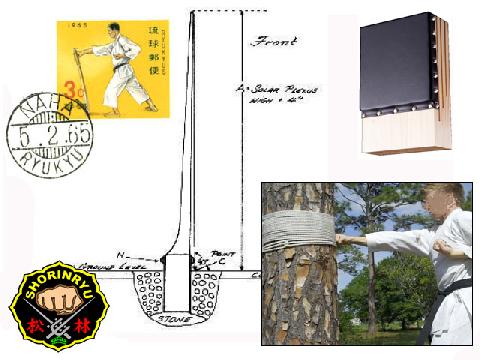
  A Matsubayashi-Ryu practitioner from the U.K. wrote me: “...why spend all that money, time and effort for a makiwara. Just wrap some rope around a tree and punch and kick away. Problem Solved!”

  Well, actually, no. Problem not solved but Emergency Room visit created.

  Physics 101: Moving Fist + Immobile Tree + Abrupt Deceleration = Damage to the weakest of the two (i.e. you fist - or foot) When one object collides (at speed) into an immobile object one or both of the objects must absorb the force of the impact. The least solid or more poorly constructed object deforms to absorb the force of impact. If you strike a tree makiwara (not a sapling) the tree will not deform but your fist/foot will.

  You ever wonder why they don’t build cars out of iron? They would withstand substantial impacts without even a scratch. However if they did not deform then the object inside the care (you) would. Better a bumper than my face. Its different but still the same basic physics involved in the fist vs. tree.

  Think about it; I, and most yudansha, can easily break multiple concrete slabs, roofing tile, multiple wooden slabs, etc. It’s not magic, again it’s physics and “mizo no kokoro”. But you know something, I never lay them on the floor and try to break them because I’m not stupid. I place them on a support that allows the energy of my strike to be absorbed into the object (e.g. concrete) causing it to deform and shatter. With multiple layers I simply have to maintain the energy of my strike and the first block will help break the second, etc. While it’s the law of diminishing returns, it still works.

  For those of us old enough to remember the massive “ice block breaks” from the 70’s, it would appear I’m inaccurate in my statements. Two words: piano wire. Yes I’m sure.

  Well what about when practitioners get hit with the 2x2 while holding a stance in demos? Repeat after me: Not magic - physics. I don’t have to have assume the “secret iron horse stance of Kusanku”, I just have to be pretty stable and trust my kohai. They must strike me with the 2x2 with the grain and choke up on the beam so that more of the beam extends past me than between the kohai and the target (me). I do not break the beam, I merely stop it, then physics kicks in: an object in motion tends to stay in motion. The momentum of the 2x2 causes it to break itself.

  Back to the makiwara. A satisfactory makiwara must have play and flexibility in it. (See graphic above) A 4x4 tapered to a 1x4 allows that flexion. I’ve also seen wood squares cut with open spaces to allow flexion when struck. While that’s not idea, it is far better than placing a rag on a concrete wall and punching it.

  When one achieves yudansha status it is not an end rather the very beginning of learning. The best learning starts with a question and a refusal to believe in magic or secret techniques. Again karate is not about secret techniques . . . well maybe it is, to some of us common sense can seem fairly elusive at times.

T.F.Y.Q.A.


Cox Hakase

Wednesday, January 30, 2013

The Hidden Bunkai of Words


  As Westerners we can be quite the idiots. We have this belief system "Orientals" are inscrutable, mystical and in contact with the mysteries of the universe which elude us. So in karate we look for the "hidden secrets". When the Okinawan masters say "there are no secrets" we don't accept it, we think "Ahhh. . . they're hiding something!?" If its hidden, its hiding in plain sight.

  If the Okinawan Masters doesn't admit there are secrets we set out to discover them for ourselves. Worse case scenario, the Okinawans acquiesce and reveal the "secrets" i.e. make them up. Then we walk around, obi tied tight, secure in the knowledge we have received transmission of the "secrets" of Okinawan karate-do. Heck even my old (1973) promotion certificates states "This is to certify that the above named person has learned Karate-Do secrets of karate training…"

  Somehow this belief in undiscovered secrets has worked it's way into our dojo training. Not only that but it has colored that training and not in a very helpful way.

  Take the Naihanchi katas. Most American Masters still teach the Naihanchis have no actual bunkai applications. Yet martial arts history researchers now know the Naihanchis are taken from the Chinese Niafunchin forms which do have bunkai as it was originally a Chinese grappling kata.

  So, are the Okinawan's hiding secrets from us in the Naihanchi katas? Or is it simply political prejudice? There is history to support the latter; when Funakoshi took the katas to Japan the Japanese felt the katas were too "Chinese" coupled with Japans complete disdain of the Okinawans as lower class citizens (the remnants of which remains today). The katas simply were not hard-core enough so, Funakoshi changed them, making the katas more acceptable to the Militaristic pre-WWII Japanese society.

  But still we look for, and see things that are not there.

  Ananku. So the kata depicts battling multiple assailants simultaneously. Bunkai everywhere and then suddenly, in the middle of the kata, we stand in a Pinan yoi stance before returning to combat. Seriously, does anyone really believe in the midst of a fight the defender would stop, stand up and wait for an attacker to regroup? I mean REALLY?

  Okay lets look at the name of the kata; Ananku. Developed by Kyan Chotoku, translated it can mean "Light from the South" or "Peace from the South" and probably refers to a visit he made to the island of Formosa (now Taiwan). "Peace from the South", hmmm, the Pinans mean peace. The ready position in the middle of the Ananku is the Pinan yoi position. If you were practicing Ananku on the beach of Okinawa facing inland (to ensure no one was watching your practice) you would start Ananku facing the East which would mean when you were in the kata, in this position you would be in the "Peace" stance facing South. Formosa is to the south of Okinawa. Hmmmm . . . . Homage to teachers in Formosa or maybe it was the Chinese Dim-Mak [delayed death touch] technique learned by Kyan in his travels?! Which makes more sense to you?.

  Let me provide a more easily to understand example.

  The other night I was re-visiting the Yakouski kumites. I've always disliked practicing them because they made little sense to me.

  We got into a discussion about the execution of techniques in the kumities. Specifically yakasuki kumitee #4. You've turned your back on an standing attacker and walk away. 3 steps later the attacker grabs your shoulder. Your turn, high block to defect the incoming head punch then simultaneously block a left low punch and deliver a right chest punch.

  The discussion led to, does the attacker walk directly to the side of the defender, or does the attacker adjust their steps to place themselves directly behind the defender (the traditional position).

  The discussion led to a decision that if the attacker lines up directly behind the defender then when the defender turns they are off-set from the attacker and in a better tactical position. This is an excellent rational.

  However there are a couple of problems with this logic:

    1) At the beginning of YK4 you are walking away from an assailant who just attacked you; turning your back on them while the assailant is still well within attack range. Does that make any sense? No.

    2) Knowing the attacker is behind you, when they place their hand on your shoulder, why wouldn't you do step forward and away rather than simply turning blindly to your left without looking? Does that make any sense? No.

    3) When you turn, you stand there, like a log, and block. Does that make any sense? No.

  So given the above, why would it then make sense to change one move (i.e. the steps) because it made tactical sense when the form is rife with tactical ineptitude???

  Each one of the other 6 YKs can be also, and equally, dismantled to discover the tactical ineptitude inherent in the forms.

  If, in the middle of a kata, an Okinawan scratches their nose, some Westerner will be certain they have spotted a "secret" signal and ascribe a bunkai application to the move.

  Okay I told you at the beginning I did not like the Yakusoku Kumites. Now I know why: my obtuseness. Let's look of the hidden bunkai of the Yakusoku Kumites in the name "Yakusoku Kumite" itself.

  Many practitioners will teach you that "Yakusoku Kumite" means "pre-arranged sparring". This is not accurate. While the Yakusoku Kumites ARE pre-arranged sparring that is not how they are translated.

  Yakusoku Kumite, translated, means "Promise Kumite". "Promise"? What's the promise? As a two man prearranged sparring technique, the promise is "I promise not to hurt you" as you promise me as well. Okay, now we're onto something.

  Who in the dojo promises not to hurt another member of the dojo? Certainly not the yudansha. As yudansha we are expected to have the degree of control necessary NOT to hurt another person in sparring unless we are engaged in Iri Kumi (knockdown kumite).

  Well that leaves the mudansha (we're getting closer). With a Mudansha practicing the YKs it would make perfect sense to promise not to harm each other with the technique.

  Now lets look at history. Osensei ALWAYS admonished great care when engaged in Jiyu Kumite (free sparring). At one point he prohibited Jiyu Kumite in his dojos as a way of avoid injury for a period. So the history is established.

  Now lets look at how we learn to free spar and when we start Jiyu Kumite. In most American schools once you achieve green belt you suddenly can start Jiyu Kumite. That makes no sense. How does a student learn how to control a technique? Kata does not teach it - kata only has one person. Jiyu Kumite can teach it through trial and error and blood and bruises, but not the best choice and may even account for student attrition rates.

  So, I believe, Osensei developed the Yakusoku Kumites specifically to fill the training gap between kata and sparring. The Yakusoku Kumites are not combat techniques, they have no bunkai applications. They are simply techniques linked together teaching the mudansha technique, control, stability and timing. That and nothing more.

  You take a mudansha, train them in basic kihon, mudansha katas and all 7 Yakusoku Kumites then, and only then, are they ready to ease into free sparring. NOW the Yakusoku Kumites make sense!

  Once the mudansha can complete the Yakusoku Kumites effectively, the ground is set for progression to Jiyu Kumite and later Iri Kumi.

  Yes, you can take the YKs and change them to reflect proper tactical timing, positioning and technique but you should do that with the entire Kumite not just one move and then sit back and believe you have accomplished something, you haven't, you've missed the point.

  So it's not about seeing bunkai where none exists but in stopping and thinking about technique AND training AND history AND what really makes sense (not what appears to make sense).

  As I have said before, you do not have to agree with me, heck most of you never read this far in the posting anyway (thanks for sticking it out). You may not agree with my logic but "Promise" me you'll think about it?

  TFYQA


Cox Hakase


P.S. My profound thanks to my fellow karate-ka for forcing me to think about what I thought I knew.

References:

Higaki, Gennosuke, Hidden Karate: The True Bunkai for the Heian Katas and Naihanchi, Champ Pub.

Nathan Johnson, Barefoot Zen: The Shaolin Roots of Kung-Fu and Karate, Samuel Weiser Pub.

Motobu, Choki, Okinawan Kempo (1926/1995), Masters Publications

Nathan Johnson, Zen Shaolin Karate, Charles Tuttle Co.

Nagamine, Shoshin, The Essence of Okinawan Karate-Do, Charles Tuttle Co.

Sam Palmer, Personal Communication, 1973, Satellite Beach, FL

Sakihara, Mitsugu, Okinawan-English Wordbook, University of Hawaii Press

Saturday, January 26, 2013

The Hard Part of Martial Arts

"Fighting is not scary, looking inward at oneself is scary. The journey to mastery in the martial arts cannot be achieved without a simultaneous inward journey. The scariest opponent one faces in karate is your own ego. Success in the martial arts correlates with knowledge and acceptance of one's self."

Cox Hakase